Introduction to ChatGPT for Blogging & SEO
Every blogger dreams of publishing content that ranks well, engages readers, and drives consistent traffic. Yet, creating high-quality, SEO-friendly content takes time, effort, and creativity. That’s where ChatGPT enters the scene. This AI-driven writing assistant is transforming the blogging landscape by helping creators save time, brainstorm new ideas, and optimize content for search engines.
The key is knowing how to use ChatGPT for blogging & SEO effectively. Instead of replacing writers, it acts as a partner—enhancing creativity, simplifying keyword integration, and making blog writing more strategic than ever before.
What is ChatGPT and How Does it Work?
ChatGPT is an advanced AI language model powered by deep learning and natural language processing. It can generate human-like text, answer questions, and even create structured content like blog posts and marketing copy.
Here’s how it works in simple terms:
- You give ChatGPT a prompt (e.g., “Write an SEO-friendly blog introduction about travel tips”).
- The AI analyzes the input using trained data.
- It generates text that feels natural, engaging, and contextually relevant.
For bloggers, this means you can go from a blank page to a fully formed article draft in minutes. The AI is versatile enough to adapt tone, depth, and complexity, making it suitable for different blogging niches.
Why Bloggers Should Embrace ChatGPT
Instead of worrying about AI taking over, bloggers should see it as a productivity booster. ChatGPT offers unique benefits such as:
- Time efficiency: Drafts and outlines are generated in minutes.
- Creative push: It sparks ideas when you’re stuck.
- Consistency: Helps maintain a publishing schedule.
- SEO support: Suggests keyword placements and optimizations.
Think of it this way: while you focus on personal experiences, insights, and storytelling, ChatGPT handles the heavy lifting of structure, research, and initial drafts.
SEO Benefits of Using ChatGPT
One of the strongest advantages of ChatGPT is its SEO potential. Here’s what it can do:
- Generate keyword-rich content that flows naturally.
- Write meta descriptions that improve click-through rates.
- Create optimized headlines that blend power words with SEO terms.
- Assist in topic clustering by suggesting supporting articles.
- Refresh old content with new keyword suggestions.
Used strategically, ChatGPT doesn’t just save time—it helps improve visibility in search results.
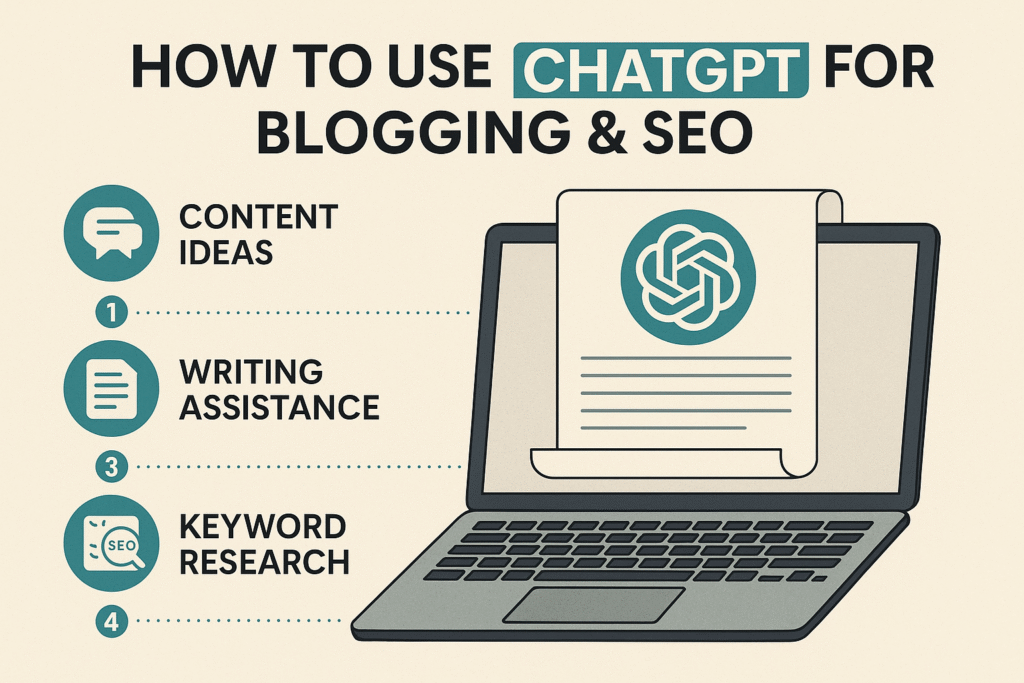
How to Use ChatGPT for Blogging & SEO
So, how exactly can you integrate ChatGPT into your blogging workflow? Here’s a step-by-step approach:
- Start with keyword research (AI can help generate long-tail terms).
- Ask ChatGPT to create content outlines.
- Generate blog drafts based on SEO-friendly prompts.
- Edit and refine the draft to add your unique voice.
- Use AI to create meta tags, titles, and descriptions.
- Incorporate SEO optimization tools for final checks.
This hybrid method—AI plus human editing—ensures content is optimized, original, and engaging.
Keyword Research with ChatGPT
Finding the right keywords is the foundation of SEO blogging. ChatGPT can:
- Suggest long-tail keywords.
- Identify semantic variations.
- Generate topic clusters around a main keyword.
- Help analyze competitors’ keyword strategies.
For example, instead of just targeting “SEO tips,” ChatGPT can help you uncover variations like:
- “SEO tips for beginners”
- “Advanced SEO strategies for bloggers”
- “ChatGPT SEO workflow”
This gives your content greater depth and a better chance to rank for multiple search queries.
Generating Blog Post Ideas with ChatGPT
Stuck for inspiration? ChatGPT can brainstorm endless blog topics based on your niche. For example, if you run a fitness blog, you can ask:
👉 “Give me 20 blog ideas around fitness trends in 2025.”
The AI will return fresh, SEO-friendly ideas like:
- “How AI is Shaping Fitness Coaching in 2025”
- “The Best Home Workouts for Busy Professionals”
- “Why Virtual Fitness Communities Are Growing”
This ensures you never run out of engaging content ideas that align with what your audience is searching for.
Crafting SEO-Friendly Titles
Headlines make or break your blog. They need to be click-worthy and keyword-rich. ChatGPT can help by generating multiple variations.
Example prompt: “Write 10 SEO-friendly titles for a blog on healthy meal planning.”
The AI will return suggestions like:
- “10 Easy Healthy Meal Planning Hacks for Busy Weeks”
- “Healthy Meal Planning: A Beginner’s Guide to Eating Smarter”
- “Boost Your Energy with These Healthy Meal Plans”
By blending power words, numbers, and emotion, these titles not only rank but also attract clicks.
Writing Blog Introductions with ChatGPT
A good blog intro must hook the reader while including the target keyword. ChatGPT can generate engaging introductions with strong hooks.
Example: Instead of writing a flat intro, ChatGPT might start with:
“Ever wondered why your blog posts don’t rank despite hours of effort? The secret often lies in SEO—and with the right tools like ChatGPT, you can change the game.”
This style instantly captures attention and sets the tone for the rest of the article.
Structuring Blog Posts with AI
Structure is vital for SEO readability. ChatGPT can create clear outlines with headings, subheadings, and logical flow. This ensures:
- Better user experience.
- Higher dwell time.
- Improved SEO signals to search engines.
With ChatGPT, you can request: “Create a blog outline on how to use Pinterest for business.” and instantly receive a structured flow ready for expansion.
Creating Meta Descriptions with ChatGPT
Meta descriptions are often overlooked, yet they play a huge role in click-through rates. ChatGPT can generate multiple variations under 150 characters while incorporating the main keyword.
Example:
👉 “Discover how to use ChatGPT for blogging & SEO to write faster, optimize posts, and increase rankings.”
Short, keyword-rich, and compelling—exactly what Google loves.
Content Expansion and Topic Clusters
One way to dominate search rankings is by using topic clusters. ChatGPT can help you:
- Expand blog posts into pillar content.
- Suggest related articles for internal linking.
- Generate FAQs to target featured snippets.
This strengthens your site’s topical authority and builds a robust content ecosystem.
Optimizing for Readability
SEO isn’t just about keywords—it’s also about user experience. ChatGPT can simplify complex sentences, shorten paragraphs, and improve readability scores.
By breaking down information into smaller chunks with headings, lists, and bullet points, AI ensures your content is easier to scan, keeping readers engaged longer.
Overcoming Writer’s Block
Every blogger faces those days when ideas just won’t flow. ChatGPT acts as a creative partner, generating outlines, opening lines, and even brainstorming unique angles to spark your creativity again.
How to Use ChatGPT for Blog Editing
Beyond writing, ChatGPT helps refine content. It can:
- Rephrase awkward sentences.
- Correct grammar and spelling.
- Suggest better word choices.
- Simplify overly technical language.
This ensures your content feels polished and professional before hitting publish.
Creating FAQ Sections with ChatGPT
Adding FAQ sections is one of the best ways to capture Google snippets. ChatGPT can generate common questions and concise, SEO-rich answers.
For example:
How does ChatGPT help with SEO?
ChatGPT assists with keyword research, meta descriptions, content structuring, and more.
Such sections improve both user experience and search visibility.
Content Personalization with AI
Not every audience wants the same tone. ChatGPT allows bloggers to adapt content to:
- A formal professional tone.
- A casual conversational style.
- A storytelling format.
This personalization makes your content resonate with different reader groups.
Using ChatGPT for Link-Building Content
AI can assist with:
- Drafting guest post pitches.
- Writing outreach emails.
- Creating resource-based blog posts that attract backlinks.
By streamlining outreach, ChatGPT makes link-building campaigns more effective.
Repurposing Blog Content with ChatGPT
One blog post can become multiple content pieces:
- Social media posts (Twitter threads, LinkedIn snippets).
- Email newsletters.
- Podcast scripts or YouTube outlines.
ChatGPT helps repurpose content, extending reach across platforms.
Potential Challenges and Limitations
While ChatGPT is powerful, it’s not perfect. Challenges include:
- Risk of inaccuracies if content isn’t fact-checked.
- Tendency to produce generic outputs without human editing.
- Possible overuse of keywords without careful prompts.
That’s why a human touch is always needed for editing, fact-checking, and injecting personality.
Ethical Blogging with AI
To maintain credibility, bloggers should ensure:
- Content is original and plagiarism-free.
- AI is used as a tool, not a full replacement.
- Transparency about AI-assisted writing when necessary.
Ethical use of AI builds trust with readers and search engines alike.
Best Practices for Using ChatGPT in SEO
- Always fact-check AI-generated content.
- Use ChatGPT for drafting, not publishing raw output.
- Combine with SEO tools for optimization checks.
- Add your unique voice and expertise.
Tools to Combine with ChatGPT for SEO
Pair ChatGPT with powerful SEO tools like:
- SEMrush (keyword insights).
- Ahrefs (backlink analysis).
- Surfer SEO (content optimization).
- Yoast SEO plugin (WordPress on-page checks).
This combo ensures AI + SEO tools + human expertise = maximum results.
Future of Blogging with AI
The future is AI-assisted, not AI-dominated. Bloggers who embrace tools like ChatGPT will gain a competitive edge, producing content faster, smarter, and more strategically. Hybrid workflows—AI for structure, humans for creativity—will define the future of blogging.
How to Use ChatGPT for Blogging & SEO
At its heart, using ChatGPT for blogging & SEO is about balance. AI speeds up the process, but your human creativity ensures authenticity. Together, they form a powerful duo for growth, engagement, and long-term blogging success.
FAQs
Can ChatGPT write a blog post by itself?
Yes, but it’s best to edit AI-generated drafts to add expertise and ensure accuracy.
Is using ChatGPT for SEO considered black hat?
No, as long as content is original, fact-checked, and value-driven, it’s a legitimate strategy.
How do I make ChatGPT outputs unique?
Customize prompts, edit drafts, and add personal insights to differentiate content.
Can ChatGPT replace SEO tools like SEMrush?
No, it complements them but cannot replace in-depth keyword analysis and tracking.
Is AI-generated content penalized by Google?
Not if it provides value, maintains originality, and follows SEO best practices.
What’s the best way to start using ChatGPT for blogging?
Begin with keyword research, generate outlines, and gradually integrate AI into your workflow.
Conclusion
Blogging has always been about creativity, storytelling, and consistency. With ChatGPT, bloggers gain a powerful ally that accelerates workflows, enhances SEO strategies, and makes content creation more enjoyable. The key is using AI wisely—letting it handle structure and optimization while you focus on insights and authenticity.
The future belongs to bloggers who embrace AI not as a replacement but as a partner. By learning how to use ChatGPT for blogging & SEO, you can create faster, rank higher, and stay ahead of the competition.