Introduction to AI Writing Tools in 2025
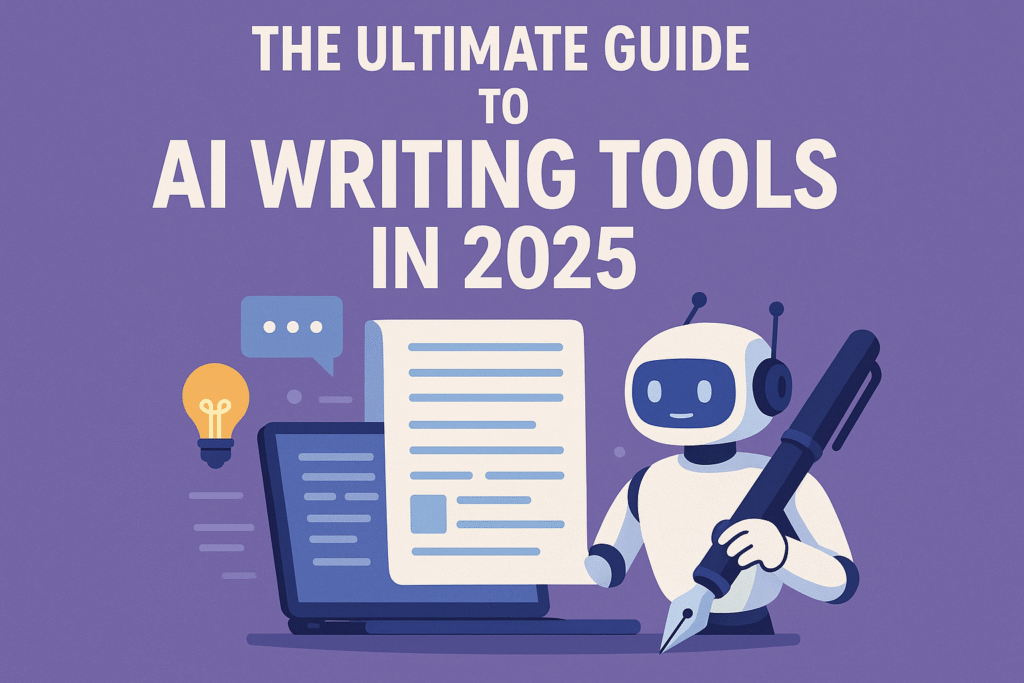
Artificial intelligence has been rewriting the rules of content creation for years, but AI writing tools in 2025 mark a turning point. What began as simple spelling correctors and grammar assistants has evolved into intelligent, context-aware co-authors that generate entire articles, optimize for SEO, and adapt to different tones and voices.
In today’s digital-first world, businesses, bloggers, students, and professionals are increasingly leaning on AI-powered platforms to meet the relentless demand for high-quality content. The key difference in 2025? These tools don’t just assist—they collaborate, elevate, and accelerate writing.
This guide unpacks everything you need to know about AI writing tools in 2025, from their top features and benefits to their ethical considerations and future potential. Whether you’re a content marketer, entrepreneur, or curious writer, this resource will help you navigate the expanding AI writing landscape.
AI Writing Tools in 2025
By 2025, AI writing tools are more than just text generators. They are multi-layered writing ecosystems. Equipped with advanced natural language processing (NLP) and trained on massive datasets, these tools can now:
- Understand context with greater precision
- Generate SEO-optimized articles in seconds
- Create engaging ad copy tailored to specific audiences
- Summarize lengthy research reports into bite-sized insights
- Support multilingual communication without losing nuance
Unlike early tools, which often required heavy editing, today’s AI writers produce content that is polished, original, and in many cases, indistinguishable from human writing.
The Rise of Generative AI for Writers
Generative AI has transitioned from novelty to necessity. In 2025, these systems act less like assistants and more like creative collaborators. Writers no longer need to start from scratch. Instead, AI provides a solid foundation—whether that’s a draft, a catchy headline, or a persuasive product description.
Interestingly, many professionals now describe AI as their “creative partner.” For example:
- A marketer brainstorming 50 unique slogans in minutes
- A blogger generating detailed outlines instantly
- A novelist experimenting with alternate story arcs
Rather than replacing creativity, AI enhances it by offering endless possibilities and fresh angles.
Top AI Writing Tools in 2025
The market in 2025 is rich with options, but some tools stand out because of their adaptability and advanced features. Let’s look at some of the most popular categories:
Best Tools for Bloggers
Bloggers rely on platforms like Jasper, Copy.ai, and Writesonic, which offer SEO-focused templates, automatic keyword integration, and blog-specific formatting.
AI for Copywriters
Marketers favor tools that excel in persuasive, short-form content. Writesonic and Copy.ai dominate this space with pre-built frameworks for ads, sales letters, and landing pages.
AI for Businesses
Large organizations prefer enterprise-grade tools like ChatGPT Enterprise and Jasper Business Suite, which integrate with CRM systems and offer scalable solutions.
AI for Academic Writing
Students and researchers use tools like GrammarlyGO and Scite AI, which combine clarity improvement with citation generation and plagiarism detection.
Benefits of Using AI Writing Tools
The appeal of AI writing tools in 2025 comes down to four key benefits:
- Time-Saving Advantages: What used to take hours now takes minutes.
- Cost Efficiency: Businesses save money on hiring extra staff or freelancers.
- SEO Optimization: Tools suggest keywords, meta descriptions, and headings that rank.
- Creativity Boost: Writers get past blocks with AI-generated ideas and outlines.
For many, AI has shifted writing from a stressful task to a streamlined process.
Challenges with AI Writing Tools
Despite the progress, AI writing tools aren’t flawless. Common challenges include:
- Plagiarism Concerns: Overlapping training data may produce similar phrases.
- Over-Reliance on AI: Some users risk losing their personal voice.
- Quality Control Issues: Without editing, some content can feel generic.
The key is using AI as a support system, not a complete replacement for human creativity.
How AI Writing Tools Support SEO
Search engine optimization remains central to digital writing. In 2025, AI writing tools are not only keyword-aware but also capable of real-time SEO scoring.
They help with:
- Keyword clustering and semantic variation
- Writing optimized meta descriptions
- Suggesting structured content with clear headings
- Identifying readability improvements
In short, they ensure that content is not only well-written but also search engine friendly.
AI and Content Marketing in 2025
AI has infiltrated every corner of content marketing. Some notable use cases include:
- Personalized Marketing Content: AI tailors messaging to specific audiences.
- AI in Social Media: Tools create optimized captions and hashtags.
- Automated Email Campaigns: AI generates subject lines with high open rates.
By automating repetitive work, AI lets marketers focus on strategic growth.
AI Writing Tools vs Human Writers
This is the million-dollar debate: can AI replace human writers? The short answer—no. AI excels at speed, consistency, and research, while humans bring creativity, empathy, and emotional depth.
The sweet spot is collaboration:
- AI drafts, humans refine.
- AI generates ideas, humans add storytelling.
- AI handles SEO, humans inject brand personality.
When combined, they deliver content that’s both efficient and authentic.
Best Use Cases for AI Writing Tools
Some of the most effective use cases in 2025 include:
- Blog Writing: Long-form, SEO-ready posts
- Ad Copy Creation: Catchy, persuasive lines
- Technical Documentation: Clear, structured guides
- Academic Papers: Drafting, citing, and summarizing research
These tools are not just for professionals—students, small businesses, and even hobbyists can benefit.
Free vs Paid AI Writing Tools
While many free AI writing tools exist, they often come with limitations such as word caps, fewer templates, or lack of integrations.
Paid tools, on the other hand, provide:
- Advanced SEO features
- Custom tone of voice settings
- Team collaboration capabilities
- Priority support and updates
For serious users, investing in premium AI writing software is well worth it.
AI Writing Assistants for Businesses
Businesses are perhaps the biggest beneficiaries of AI writing tools. In 2025, companies use AI to:
- Draft internal communications
- Create reports and presentations
- Automate customer support responses
This not only saves time but also ensures a consistent brand tone across all platforms.
How AI Improves Research and Fact-Checking
AI’s role extends beyond writing—it now aids in accurate research. Tools like Scite and Elicit AI summarize academic papers, provide references, and cross-check data.
Writers can now ensure their work is both insightful and reliable, reducing misinformation risks.
The Role of AI in Multilingual Writing
One of the most exciting features in 2025 is AI’s ability to break language barriers. Modern tools allow users to:
- Translate content without losing tone
- Write simultaneously in multiple languages
- Reach global audiences with ease
This democratizes content, giving businesses access to new markets.
Ethical Considerations in AI Writing
With great power comes responsibility. Some concerns include:
- Authenticity of Voice: Does content still reflect the author’s true perspective?
- Avoiding Misinformation: How accurate is AI-generated data?
- Bias in Training Data: Can AI unintentionally reflect harmful stereotypes?
Writers must strike a balance between AI assistance and ethical responsibility.
AI Writing Tools and Education
AI in classrooms is a double-edged sword. On one hand, it helps students improve grammar, clarity, and structure. On the other, it raises concerns about academic integrity.
Some institutions embrace AI as a teaching aid, while others impose strict guidelines to prevent misuse.
Future Trends of AI Writing Tools
The future looks even brighter. Expect to see:
- Smarter Context Understanding: Tools that adapt to your personal writing style.
- Voice-Activated AI Writers: Create by speaking, not typing.
- Deeper Integrations: AI connected to every productivity tool you use.
Simply put, AI will become an invisible but indispensable writing partner.
How to Choose the Right AI Writing Tool
Not all AI tools are created equal. When selecting one, consider:
- Your writing goals (SEO, blogs, academic)
- Integration needs (CMS, CRM, or social media)
- Pricing model (subscription vs pay-per-use)
- Customization options (tone, templates, voice)
The best AI tool is the one that aligns with your workflow.
Comparing the Best AI Writing Tools in 2025
| Tool | Best For | Key Features | Pricing (2025) |
|---|---|---|---|
| Jasper AI | Businesses & Marketing | SEO templates, brand voice | $49–$125/month |
| Copy.ai | Ads & Social Media | Short-form copy, campaign tools | Free–$99/month |
| Writesonic | Bloggers & SEO | Long-form blogs, keyword tools | $20–$100/month |
| ChatGPT Enterprise | Enterprise Teams | Secure, scalable AI | Custom pricing |
| GrammarlyGO | Students & Professionals | Grammar + AI writing help | $30/month |
| Scite AI | Academic Writers | Citation generation, fact-checking | $15–$60/month |
AI Writing Tools for Different Industries
- Healthcare: Patient-friendly medical summaries
- Finance: Simplified investment reports
- Tech: Technical documentation and user guides
- E-commerce: Product descriptions and ads
Every industry benefits differently, but the core principle remains the same—faster, smarter communication.
AI and Visual Content Creation
Writing isn’t the end of AI’s reach. Many tools now integrate visual content generation—from infographics to video scripts. Writers can seamlessly transition from drafting blogs to creating accompanying visuals.
AI Collaboration with Other Tools
AI thrives when integrated. By 2025, writing tools work alongside:
- SEO platforms like Surfer SEO
- CRM systems like HubSpot
- CMS platforms like WordPress
This creates an end-to-end content ecosystem.
The Cost of AI Writing Tools in 2025
Pricing varies widely, but most tools use subscription models. Small creators might spend $20–$50 monthly, while enterprises invest thousands for advanced integrations and security.
User Experiences and Reviews
Writers report mixed but mostly positive feedback:
- Marketers love speed and SEO support
- Bloggers appreciate idea generation
- Students value grammar help
- Businesses emphasize cost savings
The consensus: AI is now a necessary tool, not just a luxury.
FAQs about AI Writing Tools in 2025
Are AI writing tools replacing human writers?
No, they complement human creativity but can’t fully replace unique storytelling.
Which is the best AI writing tool in 2025?
It depends on your needs—Jasper for businesses, Writesonic for blogs, and GrammarlyGO for students.
Can AI writing tools improve SEO rankings?
Yes, by optimizing keywords, meta tags, and readability.
Are AI writing tools free?
Some offer free versions, but advanced features usually require a subscription.
How accurate are AI writing tools in research?
Modern tools cross-check data, but human verification is still essential.
Do AI writing tools support multiple languages?
Yes, many can generate and translate content in dozens of languages.
Conclusion
The year 2025 represents a watershed moment for AI writing tools. They are no longer just handy add-ons—they are integral to the way we create, market, and communicate. By combining speed, scalability, and SEO mastery with human creativity, AI empowers writers across every field.
The future of writing isn’t man versus machine—it’s man with machine. Those who embrace this synergy will thrive in the evolving digital world.